Guide · 7 min
Confirmed Departure Itinerary: Meaning, Yes or No?
A confirmed departure itinerary is a booked journey out of mainland China. Find the Yes/No guidance for your entry type and the details to copy from your ticket.
"Confirmed Departure Itinerary" on Step 4 of the China Digital Arrival Card asks one thing: do you already hold a booked, dated ticket out of mainland China? If you are entering under 240-hour visa-free transit, the answer must be Yes, with your exit flight, train, or vessel details — this field is the proof your entire visa-free entry rests on. If you hold a visa, or you are using an ordinary visa-free policy and simply haven't booked your exit yet, the form accepts No — and an honest No is always better than an invented flight number.
The field confuses travelers because the CDAC form doesn't explain it, and because the correct answer depends on howyou are entering China. Below: what the field looks like, which answer applies to each entry type, what "confirmed" means in practice, and the mistakes that cause friction at the airline counter or the immigration booth.
What the field looks like on the form
Step 4 of the CDAC ("Travel Information Filling") shows Confirmed Departure Itinerary as a Yes/No toggle on the right-hand side, next to the inviting-entities question. Unlike Purpose of Entry, Date of Entry, Destination Cities, or Address in China, it does not carry the red required-field marker.
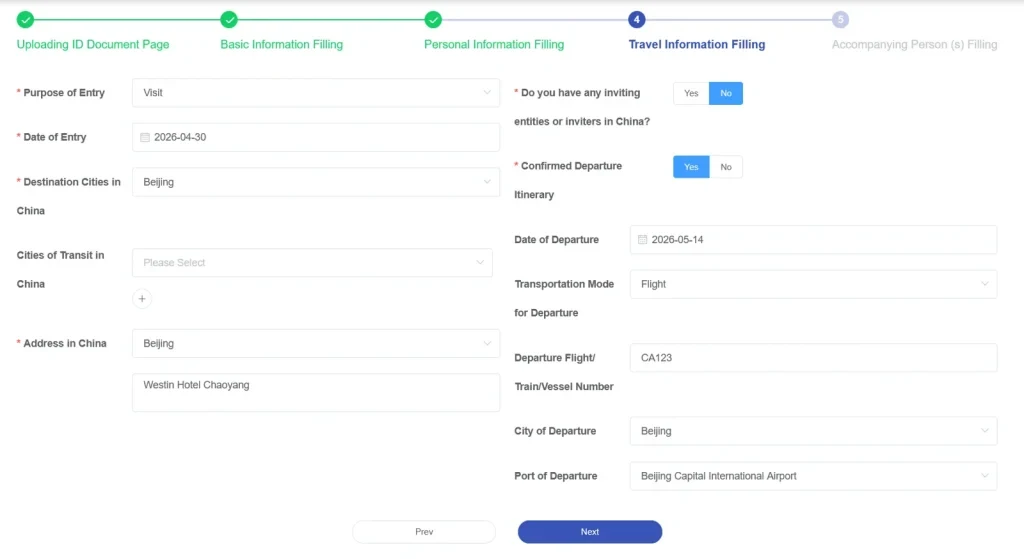
Selecting Yes reveals five sub-fields:
- Date of Departure — the date you leave mainland China.
- Transportation Mode for Departure — Flight, Train, or Vessel.
- Departure Flight/Train/Vessel Number — the operating carrier's number.
- City of Departure — the mainland city you exit from.
- Port of Departure — the specific airport, rail port, or sea port.
Selecting No hides them all and lets you continue to Step 5. This reflects the live form at s.nia.gov.cn as of 2026-07-03; NIA has not published field-level guidance, so the decision rules below come from the entry policies themselves.
Which answer applies to you
- 240-hour visa-free transit → Yes, always. The legal basis of 240h transit is a confirmed onward journey to a country or region different from the one you arrived from, departing within 240 hours. If you cannot fill these sub-fields, you don't have an eligibility problem with the form — you don't qualify for 240h transit at all. Run the eligibility check before you fly, not at the counter.
- Ordinary visa-free entry (30-day unilateral, ASEAN, and similar) → Yes if you hold a return or onward ticket, which most tourists do.If you genuinely haven't booked your exit, the form accepts No — but be aware that airline check-in desks often want to see an onward ticket for visa-free passengers regardless of what the arrival card says. That check happens at the airline's discretion, so treat "fly on a one-way with no visa" as needing airline verification, not as a settled right.
- Visa holders (work, student, family reunion, long-term) → answer what is true. A one-way relocation on a Z visa with no booked exit is a normal, honest No. The arrival card is a declaration, not an eligibility test for visa holders — your visa is your permission to enter.
What "confirmed" actually means
A confirmed departure itinerary is a ticketedjourney: a fixed date, a real seat or cabin, on a named operating carrier that an airline or rail operator can verify. It is not a refundable "hold", not a placeholder you intend to change, and not an itinerary screenshot from a booking site you never paid. For 240h transit there are two extra conditions: the departure date must fall inside your 240-hour window, and the destination must be a different country or region from the one you arrived from — Hong Kong, Macau, and Taiwan count as separate regions for this rule (see the third-region guide).
How to fill the sub-fields without errors
- Use the operating carrier's flight number, not a codeshare and not your PNR.If you booked "BA4600 operated by China Southern CZ302", enter CZ302. The six-character booking reference (PNR) is never what this field wants.
- Match the date to the ticket, in the form's date picker format. Manually typed dates in MM/DD/YYYY habits are a classic source of swapped day and month.
- Rail exits use the train number from your China Railway 12306 e-ticket (for example G6551 to Hong Kong West Kowloon), with the departure city and rail port. The HSR exit guide covers this route end to end.
- Pick the specific port, not just the city.Shanghai has two airports; "City of Departure: Shanghai" still needs the correct Port of Departure (PVG or SHA).
Where travelers get it wrong
- 240h transit + No. The card goes through, but you have declared the opposite of what your entry policy requires. Expect harder questions at immigration, and expect the airline — which checks documents against the same policy — to balk. If you did this, submit a fresh card with Yes and the real exit details before you fly.
- Exit date outside the 240-hour window.The form won't stop you, but the itinerary no longer supports 240h transit. The window is counted from 00:00 the day after entry — verify your dates with the eligibility check.
- Round trip back to the origin country. US → Shanghai → US is not a valid 240h routing no matter what you enter here; the exit must be to a third country or region.
- Inventing a flight number to force a Yes. Immigration officers can and do check. A fabricated itinerary on a signed declaration is a far worse position than an honest No — or than booking a real exit ticket first.
- Trying to edit after submitting. A submitted card cannot be edited. The fix is to submit a brand-new card with correct values and use the newest QR receipt at the border. Submissions open 72 hours before arrival, so there is usually time to redo it.
What to carry as backup
The CDAC declaration and the paper (or on-screen) proof serve different checkpoints. Whatever you enter in this field, carry evidence that matches it:
- Printed e-ticket PDF for the exit leg — passenger name, route, date, operating carrier visible.
- Booking confirmation with the airline's booking reference, in case the agent needs to look it up.
- For rail exits: the 12306 e-ticket with the seat assigned.
- If your onward leg is on a separate booking or a different alliance, airline systems may not see it — that mismatch is the top cause of denied boarding on 240h transit. A printed Boarding Kit shortens that conversation.
Related guides
- The full CDAC walkthrough — every step and field of the arrival card, with screenshots
- What hotel address to enter — the other Step 4 field that blocks people
- CDAC scam sites — the only official portal is s.nia.gov.cn, and it is free
Policy basis: NIA 240-hour transit policy (en.nia.gov.cn) and the live CDAC form at s.nia.gov.cn. Last checked 2026-07-03. Independent guide — not affiliated with NIA.